Posts

Nov. 28, 1864 - Capture of New Creek
Image
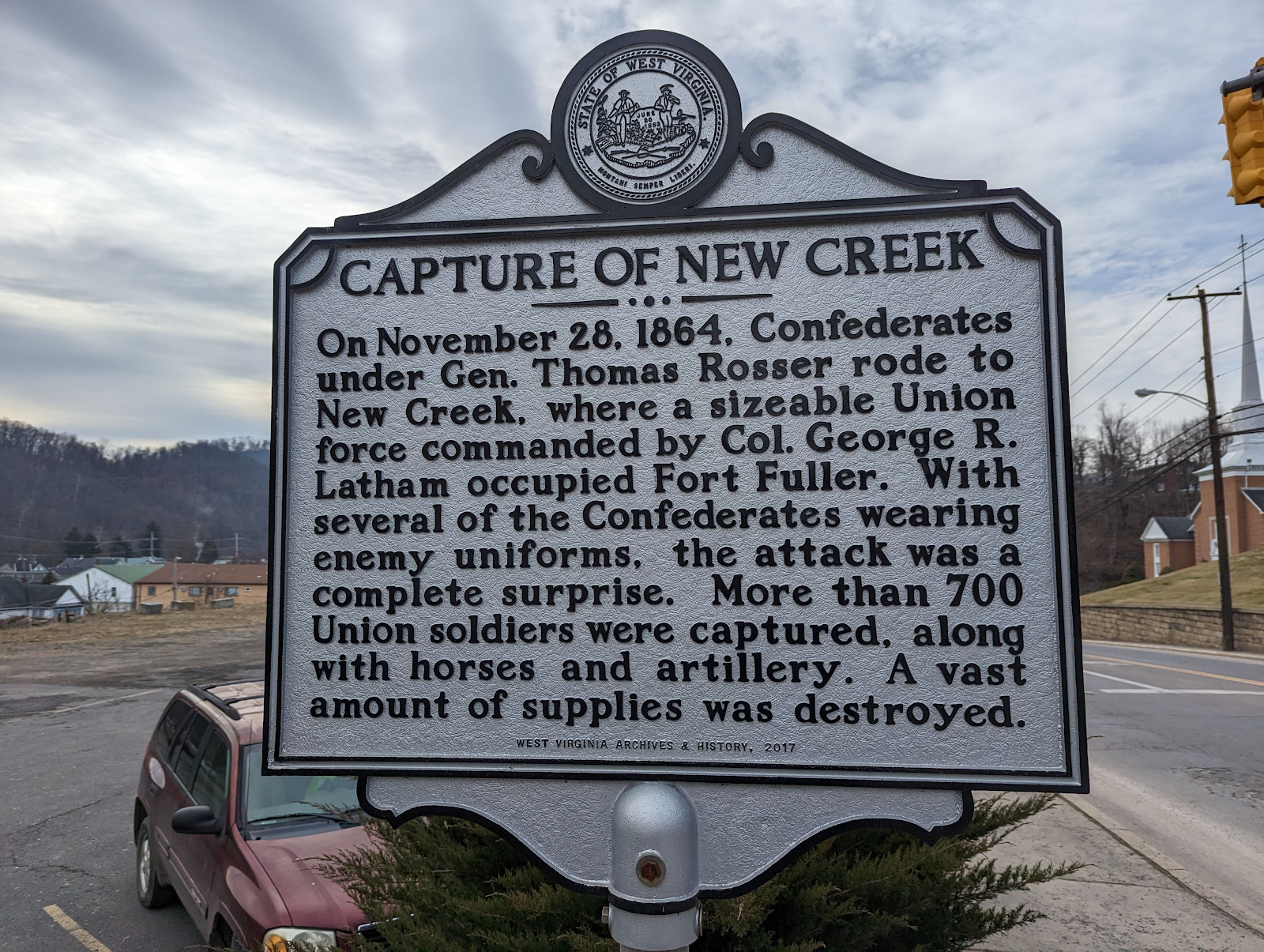
Nov. 28, 1864 Capture of New Creek New Creek aka Keyser, WV Col. George R. Latham @ Fort Fuller  vs. Confederates under Gen. Thomas Rosser "On November 28, 1864, Confederates under Gen. Thomas Rosser rode to New Creek, where a sizeable Union force commanded by Col. George R. Latham occupied Fort Fuller . With several of the Confederates wearing enemy uniforms, the attack was a complete surprise. More than 700 Union soldiers were captured, along with horses and artillery. A vast amount of supplies was destroyed." https://www.hmdb.org/m.asp?m=152788 Keyser. Between 1861–1865, Keyser, then New Creek, was sought by the North and South. It changed hands fourteen times. Fort Fuller, where Potomac State Collect stands, was supported by a series of forts girding the town. Averell’s Raid. Here in 1863 General W. W. Averell started the Federal cavalry raid to Salem, Virginia, and then back into this State. This is among the great exploits of the War. Many of his troopers were from Wes...

November 4, 1864 - U.S.S. Key West Scuttled

Image
November 4, 1865 U.S.S. Key West Scuttled  Jacksonville, Tennessee (though the marker is in Key West, FL) * The markers don't mention him, but that was actually Nathan Bedford Forrest shelling the Union ships with rifled artillery from shore.  https://www.hmdb.org/m.asp?m=226183 Key West-Florida Keys Historical Military Memorial Once called the "Gibraltar of the Gulf of Mexico, Key West occupies a vital strategic position in defense of the United States. In 1822, Lieutenant Matthew Perry, U.S. Navy, raised the American Flag over Key West, taking formal charge of the island in the name of the United States. This memorial is a time-line of significant military engagements in which Armed Forces members from the Keys participated. Each pedestal recounts the military actions depicted in the time-line beginning with the Antipiracy Campaign. Next came the Second Seminole War, the Civil War, the Spanish American War, World War I, World War lI, the Cold War, the Cuban Missile Crisis a...

Oct. 2- 5, 1864 - Custer Fights in Bridgewater, VA

Image
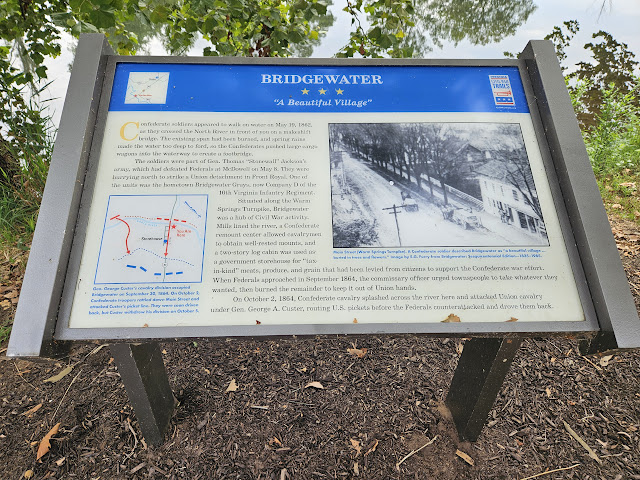
Oct. 2-5, 1864 Custer in Bridgewater Bridgewater, VA (Rockingham County) Bridgewater "A Beautiful Village" Confederate soldiers appeared to walk on water on May 19, 1862, as they crossed the North River in front of you on a makeshift bridge. The existing span had been burned, and spring rains made the water too deep to ford, so the Confederates pushed large cargo wagons into the waterway to create a footbridge. The soldiers were part of Gen. Thomas "Stonewall" Jackson's army, which had defeated Federals at McDowell on May 8. They were hurrying north to strike a Union detachment in Front Royal. One of the units was the hometown Bridgewater Grays, now Company D of the 10th Virginia Infantry Regiment. Situated along the Warm Springs Turnpike, Bridgewater as a hub of Civil War activity. Mills lined the river, a Confederate remount center allowed cavalrymen to obtain well-rested mounts, and a two-story log cabin was used as a government storehouse for "tax-in-ki...

Sept. 29, 1864 - New Market Heights [draft]

Image
Sept. 29, 1864 New Market Heights * Sgt. Hilton holds this place until I visit the Battlefield. Like Grant, we will get there eventually. https://www.hmdb.org/m.asp?m=219760 Sergeant Alfred B. Hilton Memorial Alfred B. Hilton was born between 1837 and 1842, in the area then known as Hopewell Crossroads (now Level, Maryland). He was the son of Isaac and Harriet Hilton, free citizens who were formerly enslaved in Harford County. Alfred grew up in a large family a few miles outside of Havre de Grace on Gravel Hill Road. In May of 1862, the United States Army established the Bureau of Colored Troops to oversee the active recruitment of Black soldiers, both enslaved and free. Alfred and two of his brothers, Henry and Aaron, along with other free Blacks from the area, enlisted in the 4th Regiment, USCT at a recruiting office in Havre de Grace. The Hiltons were mustered into service on August 11, 1863 in Baltimore, Maryland. Due to his aptitude and 5'10" stature, regimental officers ...

Sept. 23, 1864 - Execution of [and by] Mosby's Men

Image
Sept. 23, 1864 Execution of [and by] Mosby's Men Front Royal, VA https://www.hmdb.org/m.asp?m=2447 On 23 Sept. 1864 in a fight south of town, some of Lt. Col. John S. Mosby’s Rangers mortally wounded Lt. Charles McMaster, 2nd U. S. Cavalry, after he allegedly surrendered. Union Gen. Alfred T. A. Torbert’s cavalrymen retaliated by executing six captured Rangers nearby. They shot David L. Jones and Lucien Love behind the Methodist Church, Thomas E. Anderson beneath an Elm Tree, and Front Royal Resident Henry Rhodes in a field in front of Rose Hill. They hanged William Thomas Overby and a Ranger named Carter at the W. E. Carson house. Mosby, believing Gen. George A. Custer responsible, on 6 Nov. ordered an equal number of his men executed near Berryville. And it goes on like that...

September 19, 1864 - Third Winchester

Image
September 19, 1864 Third Winchester (AKA the  Battle of Opequon) Winchester, VA (Frederick County) US- Sheridan: ( Wright's  VI Corps and Brig. Gen. William Emory's XIX Corps; VIII Corps under  Brig. Gen. George Crook  and a cavalry division under  Brig. Gen. Alfred T. A. Torbert ) vs. CSA- Jubal Early: Breckinridge, F. Lee * Significant but costly Union victory after Early left behind limited defenses while raiding Maryland  * THE bloodiest battle of the Shenandoah Valley: more died at this battle then in the entire 1862 campaign  *    Confederate generals Robert Rodes and Archibald Goodwin were killed, and generals Fitzhugh Lee, William Terry and William Wharton were wounded. Union Brig. Gen. David Russell was killed, and generals John McIntosh, Emory Upton, and George Chapman were wounded. Yikes.  * Visiting this well-preserved battlefield entails...a lot. On my first pass through I just saw that one marker at the cemetery and ca...